Anyone who has followed a fitness plan knows the pattern. Motivation is easy in week one, and by week three the people who keep improving are the ones who tracked their numbers, trained at the right intensity and fixed their weakest movement first. Studying for a certification works the same way. Reading slides for hours feels productive, but it is the equivalent of walking on a treadmill without ever checking your pace. If you are preparing for an entry level generative AI credential, this article looks at one way to build a study routine with measurable progress, using the NVIDIA Certified Associate: Generative AI LLMs (NCA-GENL) practice tests from Be Ready Education.
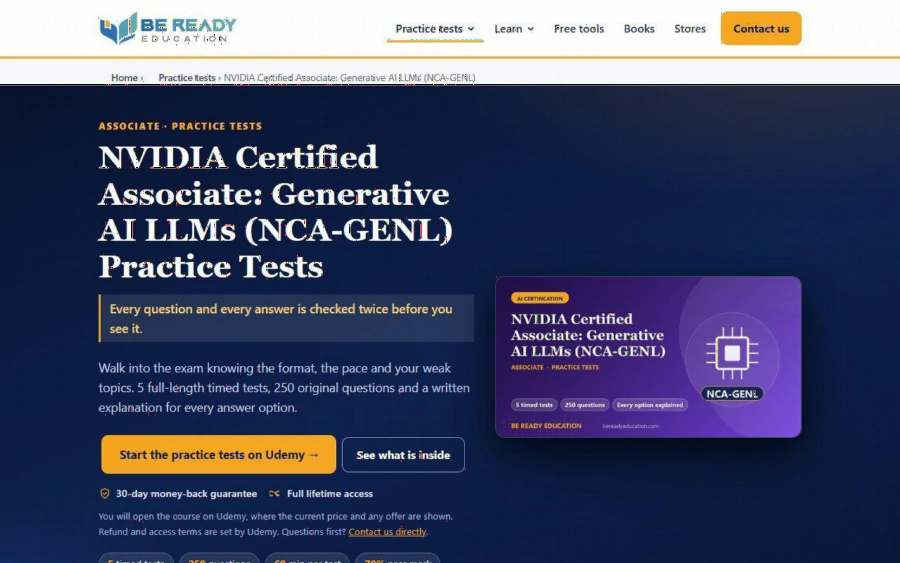
The NCA-GENL practice test page on Be Ready Education, showing 5 timed tests, 250 original questions and an explanation for every answer option
The problem: studying without a scoreboard
Large language models are now part of everyday work for junior machine learning engineers and application developers. A certification gives a hiring manager a quick signal, but preparing for it creates a different problem. The topics are wide, the vocabulary is crowded, and many concepts sound alike. Candidates tend to confuse the same things over and over: retrieval augmented generation versus fine tuning, top-k versus top-p sampling, encoder only versus decoder only architectures, and the BLEU and ROUGE metrics. Be Ready Education names exactly these four pairs on its NCA-GENL page as the ones people mix up most, which matches what many study groups report.
The deeper issue is feedback. Without practice questions you cannot tell whether you understand a concept or merely recognize it when you see it on a page. In training terms, recognition is like watching a workout video, while recall under a clock is the actual workout.
What the practice course actually offers
The product is a set of practice tests, and it is worth being precise about what that means. According to the NCA-GENL page on bereadyeducation.com, you get five full length timed tests with 50 questions each, so 250 questions in total. Each test runs 60 minutes, which works out to about 72 seconds per question. The pass mark is set at 70 percent. Every question comes with a written explanation of why the right answer is right and why each wrong option is wrong.
That last feature matters more than it sounds. If you only see a score, you learn that you missed something. If you see an explanation for all four options, you learn the shape of the distractors, which is how the confusing pairs above start to separate in your head. Think of it as a coach who corrects your form instead of only counting your reps.
The page also lists free study aids: an exam timer, a pass score calculator, a practice score tracker, and both a two week and a four week study plan. It states that the practice questions are original and are not official exam content. The publisher also says plainly that it is independent and not affiliated with NVIDIA. I find that honesty reassuring, because practice material that promises to mirror the live exam usually deserves suspicion.
Pacing, the part most candidates ignore
The official exam, as summarized on the same page from the provider's own site, lasts one hour and contains 50 to 60 multiple choice questions. Be Ready Education notes that the provider can change these details and tells candidates to confirm them on the official page before booking. That is good advice, so treat the numbers as a planning baseline rather than a promise.
If the exam is an hour long with up to 60 questions, you have roughly a minute per question. Practice tests that mirror a 50 question, 60 minute rhythm force you to build a habit of moving on from a stubborn item and coming back. Athletes call this pacing. A runner who sprints the first kilometer rarely finishes strong, and a candidate who spends five minutes on one sampling question often rushes the last ten.
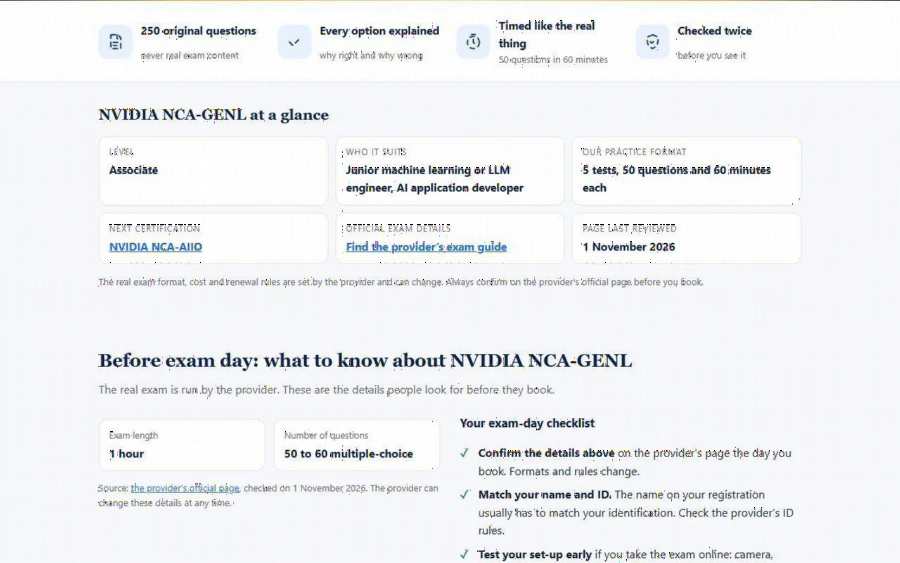
Details section of the NCA-GENL page showing level, audience, practice format and exam length
A simple training plan
Here is a routine that fits the structure of the course, using the readiness guidance printed on the page: aim for 80 percent or better on two tests in a row before you book.
1. Baseline week. Take Test 1 under timed conditions with no notes. Do not worry about the score. Read every explanation, including those for questions you got right, because a lucky guess is not knowledge.
2. Weak spot week. Write down which topics cost you points. If it is the confusing pairs, make a one page comparison for each and reread it daily. The page offers a two week and a four week plan, so pick the one that matches your calendar.
3. Timed repetition. Take Tests 2 to 4 on separate days, again with the timer on. Track each score in the free practice tracker so you can see the trend rather than guess at it.
4. Final check. Use Test 5 as your rehearsal. If you reach 80 percent or more on two tests in a row, you have evidence rather than a feeling.
Spacing the tests out is the same principle as rest days in a gym program. Your memory consolidates between sessions, and cramming all five tests in one weekend wastes most of the benefit.
Strengths and limits
There are real strengths here. The structure is clear, the explanations cover every option, and the free tools make progress visible. The page includes an exam day checklist covering name and ID matching, testing your online setup early, break rules and a timed rehearsal, which are practical details people forget until the morning of the exam.
There are also limits you should know about. The website does not take payments. You open the course on Udemy, where the current price and any offer are shown, and the page mentions a 30 day money back guarantee and lifetime access, with refund and access terms set by Udemy. I could not find a price on the site, so check Udemy before you decide. The questions are practice material, not a guarantee of any result, and no set of practice tests replaces understanding the underlying ideas. If you have never touched an LLM, you will want hands on experience or a course on fundamentals before drilling questions.
Be Ready Education does not publish comparisons with other providers on this page, and I do not want to invent one. If you already use another question bank, a sensible approach is to use it for volume and use these five tests as a timed, explained checkpoint.
Who should use it and who should skip it
The page describes the certification level as associate and the audience as a junior machine learning or LLM engineer or an AI application developer. This course fits you if you are in that group, you learn well from explanations, and you want a structured way to check readiness. It is probably not the right tool if you need deep hands on labs, or if you are aiming for an advanced credential rather than an associate level one. The same publisher lists a related next step, NVIDIA NCA-AIIO, for people who want to continue.
How to start
Start by opening the NCA-GENL practice tests page and reading the at a glance section, which shows level, audience and format side by side. Then use a free Udemy account to open the course, take Test 1 with the timer running, and read every explanation. If you want to see what else the publisher covers, the full list of practice tests shows the other vendor certifications. Confirm the current exam format on the provider's official page before booking, since those details can change.
Good preparation, like good training, is mostly consistency with honest measurement. Pick a start date, put the five tests on your calendar like gym sessions, and let the scoreboard tell you when you are ready.